 |
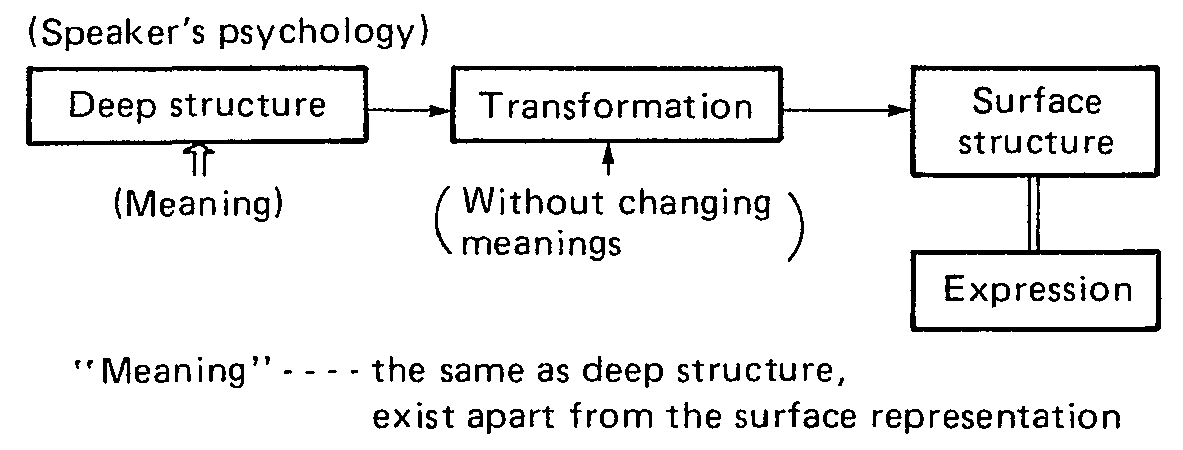
| (a) According to generation and transformation grammar (Chomsky) |
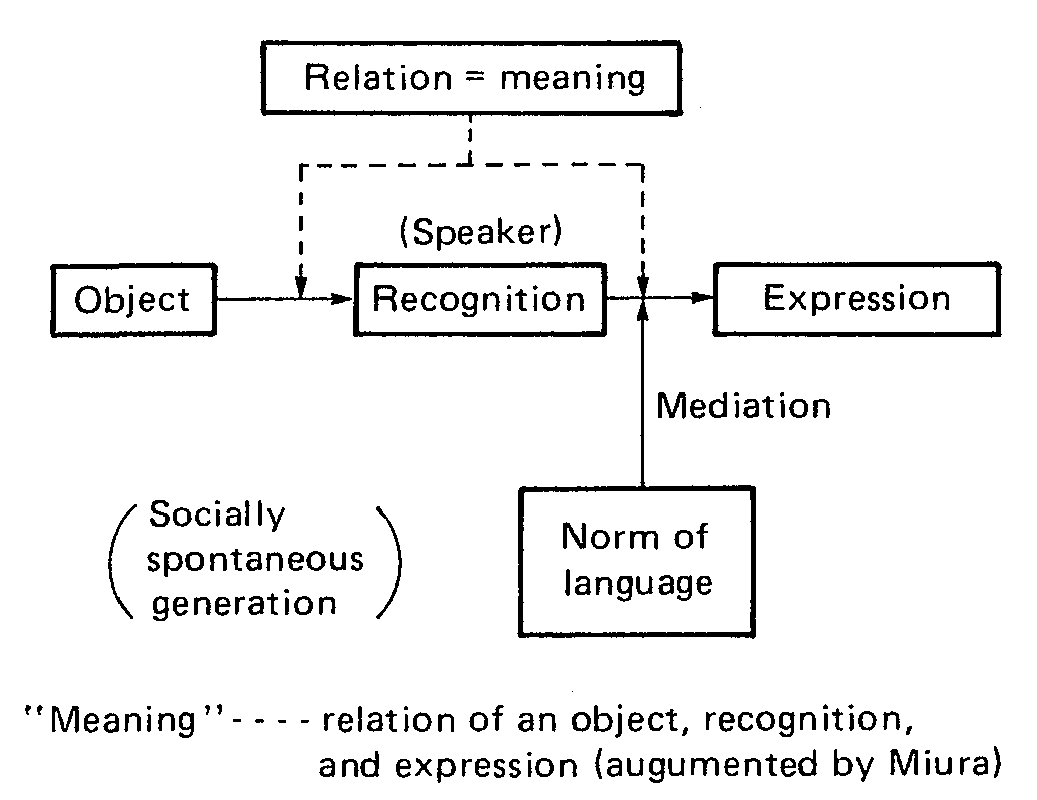 |
| (b) According to the constructive process theory (Tokieda) |
The multi-level-translation method for machine translation is proposed based on the Constructive Process Theory. It is composed of two sub-methods: a separate-recombine method and a multi-level transfer method, which are based on an analysis of the speaker's recognition of both the subject and the object, and a simultaneous analysis of the syntax and meaning.
The separate-recombine method analyzes subjective expressions to extract emotions and intentions, and then recombines them in the target language. The multi-level transfer method conveys the remainmg objective expressions in the target language by three levels of transfer, based on the degree of sentence structure abstractness.
Here, the meanings aspect of an expression's structure is considered to achieve accuracy in machine translation compared with the conventional one.
Unlike natural science, which deals with physical phenomena, research on natural language deals with a mental product. Many explanations for language have been proposed based on different interpretations of the mental function. For instance, Saussure's structuralism(1)(2) assumes that the mental function exists in an "a priori conceptual substance", and states that the content of the mental function is a linguistic norm.
Neither Saussure's, structuralism nor ordinary grammar(3), can explain homographic expressions (why the same sentence structure often has different meanings). Chomsky(4)(5) proposed that a more abstract structure must be considered to be the meaning of an expression. He introduced a "deep structure", which assumes a common thought pattern for every one. Chomsky's idea focuses on the content of an expression, but he separated the content from the object so that the reflection theory was ignored and a dualism(6)(9) was asserted, in which form opposed content. However, the state the objects, and how recognition actually occurs are reflected by the form of expression, so that the form and the content are interdependent. In addition, the speaker's recognition is connected to an expression. Therefore, a deep structure need not be assumed as a semantic structure separated from a surface structure. On the contrary, the relation between the object, the speaker's recognition of it and the expression should be considered as the true meaning.
Most current research on machine translation(8)(9) follows some form of transformational generative grammar, in which a common structure of meaning is assumed and represented in an intermediate language independent of ordinary languages. On the contrary, if the "process construction of a language"(10)(11) such as an object, recognition and an expression is considered, it becomes apparent that only the object is common to the languages and that the manner of recognition differs from person to person as well as from language to language. Therefore, it is difficult to assume a deep structure as having a meaning common to different languages. This difference in recognition structure(12)(13) between the original language and the target language should be considered in high quality machine translation.
Language is metaphysically explained as a complex body of the complete world by formalism and structuralism. An expression is explained by the functions or forms of each part of its parts.
Chomsky's explanation pays sufficient attention to the content of expressions. However, the relation between the object and the speaker's recognition is not considered. Prior to this, the Process Construction Theory proposed by Tokieda(10), claimed that language is composed of three processes: object, recognition and expression. These processes are combined by the law of causality. The state of an object reflects the speaker's recognition, therefore, the way the speaker recognizes that object results in an expression. This mental link from object to recognition and finally to expression illustrates the Process Construction Theory. The differences between Chomsky and Tokieda's theories are shown in Fig. 1.
|
(1) Recognition of the Subject and the Object
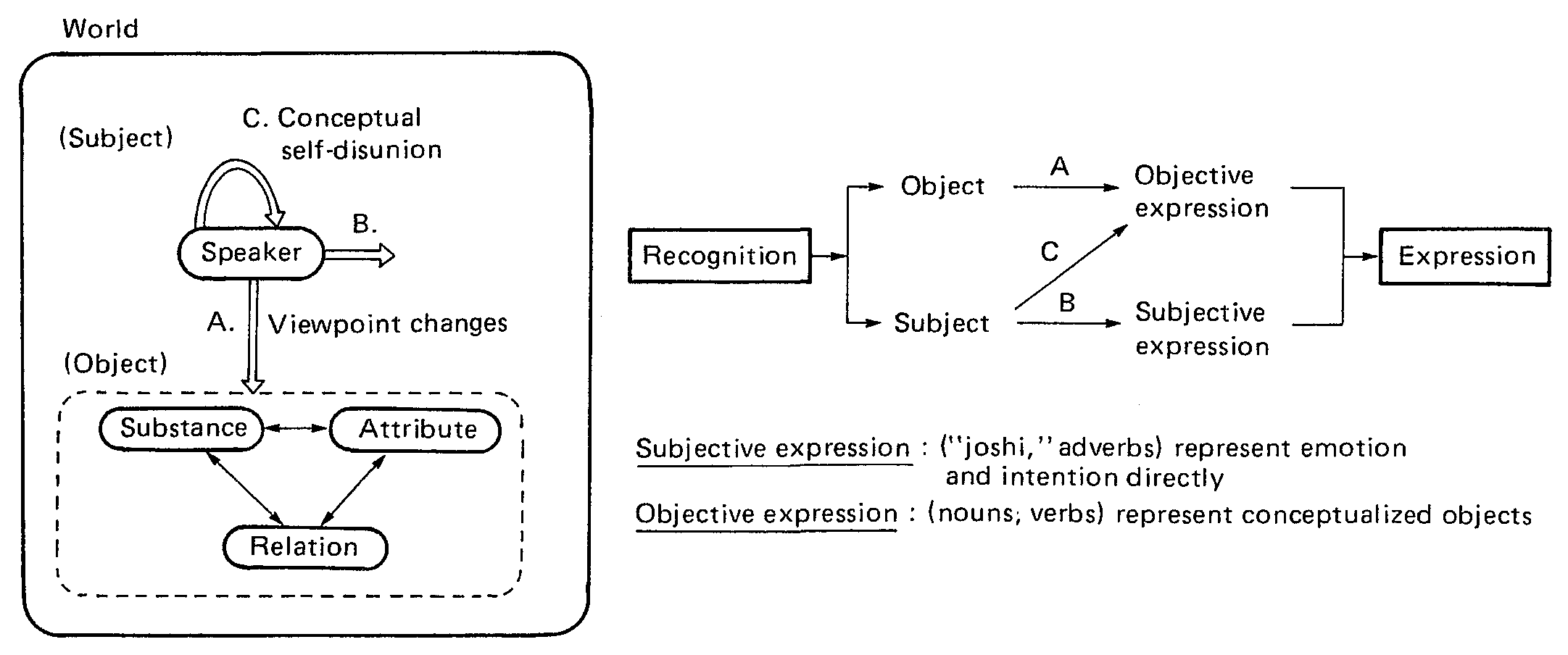
The world recognized by a speaker is composed of a subject, namely the speaker himself, and objects (Fig. 2). A speaker recognizes both his own state and the state of other objects, and connects them to expressions. Based on this, Tokieda explained that a Japanese sentence is composed of subjective expressions and objective expressions. By his definition, subjective expressions directly represent subjective emotions and intentions. Japanese adverbs and "joshi" (post-positional words functioning as auxiliaries to main words) are used for these expressions.
|
Objective expressions represent conceptualized objects. Nouns, verbs and adjectives are used for these expressions. When a speaker conceptualizes the subject (the speaker himself), the subject can be represented by these objective expressions. The relationship between subjective and objective expressions has been pointed out by Port-Royal(15) for Indo-European languages.
(2) Connection between a Recognition and an Expression
An object can be broken down into substance, attribute and relation, all of which have many structures. These structures are reflected in expressions through the speaker's recognition. The substance of an object has a hierarchical relation between a part and the whole for example. Attributes are related to the substance. Relations are mainly constructed of three further kinds of relations between substances, attributes and relations.
These components and partial structures are combined in many ways to create a total structure in the speaker's mind. The manner of recognition depends on the viewpoint of the speaker. Every language has its own framework for representing such recognition. Thus, the original structure of the object is not reflected directly in the expression, but through the speaker's recognition.
The difference between languages is the difference between the frameworks of the speaker's recognition. The relationship between subjective expressions and objective expressions in the original language should be reconstructed and expressed in the target language.
(1) A New Definition
Many explanations of the meaning of an expression have been proposed. Saussure0' distinguished "lang" as having common social significance and "parol" as having individual meaning based on individual experiences. Taking a different point of view, Chomsky made a distinction between semantic deep structure and syntactic structure. Although their perspectives are different, they agree that content is independent of the object, and that "lang" and deep structure are both common to human beings or specific human groups. A lot of current machine translation research is based on these ideas and assumes that deep structure is meaning. There are also cases where deep structure is defined as the state of an object, which differs from the speaker's recognition of it.
On the contrary, we define the meaning of an expression as the relation between the object, the recognition and the expression. This definition is based on the fact that how the subject and an object actually exist is connected to an expression through the speaker's recognition. Accordingly, the meaning (i.e. relationship) cannot exist without the expression. The ordinary meaning of a word as defined in a dictionary is not actually a meaning, but rather a language norm. Only when a word is used in an expression does the relation to a recognition and an object arise giving the word a true meaning.
(2) The Meaning of Syntactic Structure
A speaker consolidates his recognition and represents it by an expression, using rules to form words, phrases and clauses. This consolidation is based upon language norms supported by a meaning. That is, the state of the object reflects a speaker's recognition, and the speaker's recognition is reflected in an expression. This means that the syntactic structure is integral with the object and the recognition, and that the syntactic structure is part of the meaning. Unlike transformational generative grammar, where structure (a surface structure) is distinguished from a meaning (a deep structure), a surface structure can be considered part of the meaning. Therefore, transforming an expression, strictly speaking, changes the meaning. Transformation cannot leave the meaning unchanged. Transformations in ordinary language processing are transformations to alternate approximate expressions.
Thus, the element composition method, which tries to compose the whole meaning from its parts, neglects the meaning of the syntactic structure. The meaning of a part of an expression can be correctly interpreted only in the context of whole sentences. Accordingly, the rules of the meaning of a word used in the expression, can be determined only for that particular context.
A competent sentence is defined as a sentence that can be translated in isolation using only linguistic knowledge, namely, grammar and a dictionary. The multi-level machine translation method (MLMT) is proposed for competent sentences.
Japanese is classified as an agglutinative language where "joshi" and adverbs are used for subjective expressions. By contrast, English is an inflectional language, with subjective expressions usually represented by inflections. Thus, Japanese subjective expressions do not directly correspond to English ones, and it is difficult to translate word for word.
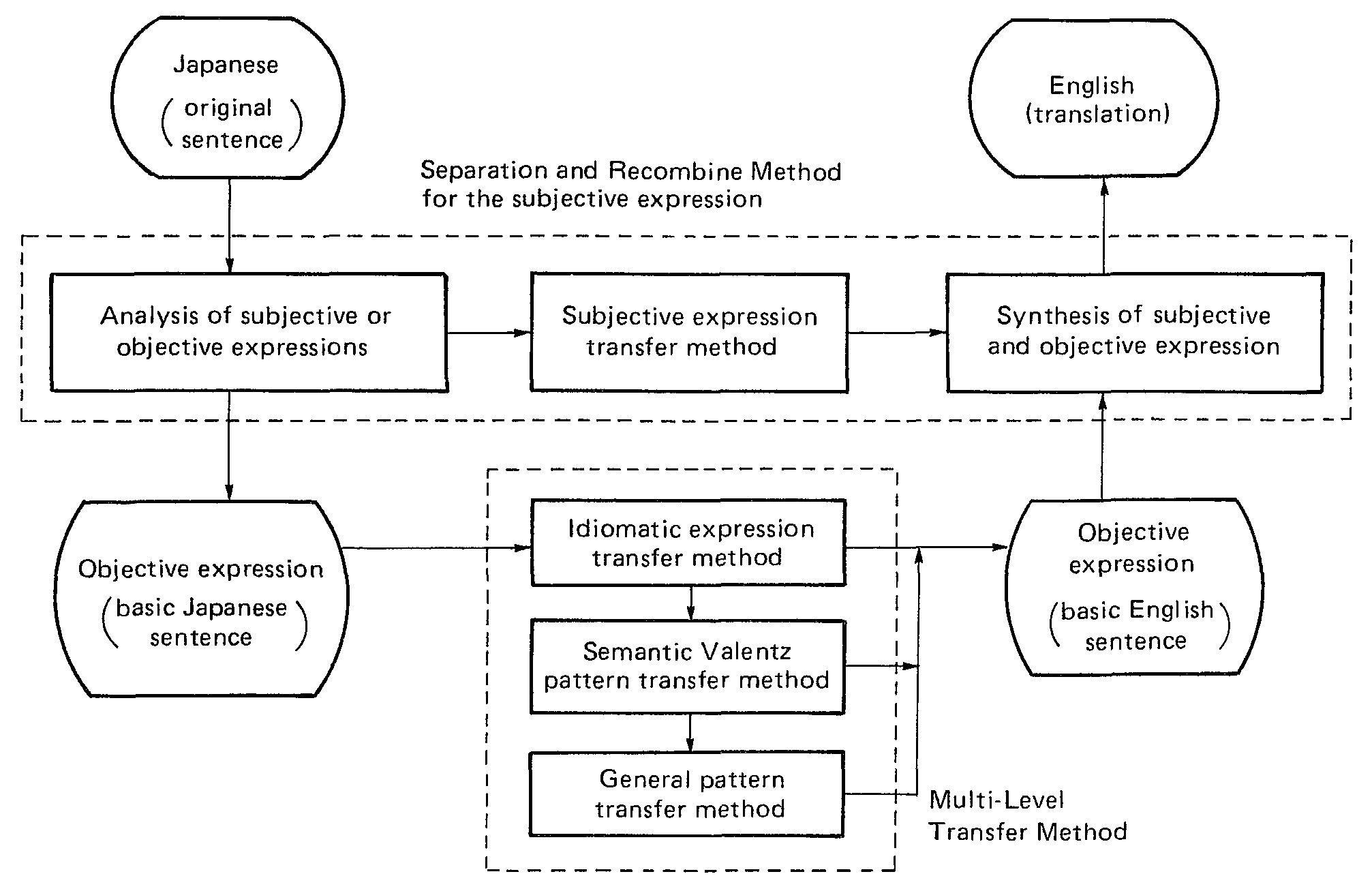
For this reason, the speaker's emotions and intentions are first classified into categories and then analyze what categories the subjective part of a given Japanese sentence represents. Thus, the original Japanese sentences are transformed into basic Japanese sentences. The Japanese sentences remaining after the subjective expressions are extracted are objective expressions.
These expressions are translated into basic English sentences by the multi-level transfer method described in the next section. Finally, the speaker's previously extracted emotions and intentions are recombined with the basic English sentences. Adverbs and prepositions are added and nouns and verbs inflected. In this way, information about the subjective expressions separated from the original Japanese sentences is recombined in creating the English sentences.
The state of the object is represented in a basic Japanese sentence (an objective expression) from the speaker's viewpoint. The speaker's recognition of an object has several structures and these structures are reflected in the structure of the objective expressions. If we strictly adhere to the that changing an expression changes the meaning and that an integrated process of syntactic structure and meaning are needed for accurate translation, then a matching English expression is needed for every possible Japanese expression. Clearly, this is not practical because of the infinite number of expressions. Thus, sentence structures are classified into three levels, according to the strength of the link between the sentence structure and the meaning. Sentence structures are transformed by a method suitable to the level.
(1) Specific Recognition Structure Level
Idiomatic expressions have meanings which cannot be determined from individual words causing extreme difficulty in translation by an element composition method. These kind of expressions therefore are completely transferred as matched pairs of Japanese and English expressions by idiomatic expression transfer rules.
(2) Individual Recognition Structure Level
More general structures are classified into this category. In specific recognition structures, the words are completely fixed. However in an individual recognition structure, a single word is fixed, and the other words are restricted by their semantic attributes. When a declinable word is fixed, the contents of other "bunsetsu" (Japanese clauses) connected to the declinable word are restricted in the use of "joshi" and the semantic attributes of nouns.
A case grammar(16) could be applied for these structures. However, a Valentz pattern0^ transfer method is more suitable as it does not require use of a deep structure, which is difficult to define precisely. In a case grammar, some of the meaning of a syntactic structure is missed in the process of deep case selection, whereas the meaning of a syntactic structure can be transferred intact using the Valentz pattern transfer method.
This paper uses the Valentz Pattern Transfer method augmented by restrictions of a word attributes. This method is supported by a system of precise and mutually exclusive semantic attributes of words. It can transfer meanings which cannot be categorized by case grammar.
Individual recognition structures are paired for corresponding Japanese and English expressions registered in a pattern dictionary similiarly to idiomatic transfer rulls.
(3) General Recognition Structure Level
Compared with both special and individual recognition structures, which are thought to be comprised by a pattern of special words or special and associated words, the general recognition structure deals with a more comprehensive patterns. In this level, a word is not fixed. For example, patterns may be classified by verb type: i.e. instantaneous or stative, etc. General patterns corresponding to groups of verbs are prepared. With this method rough translation is inevitable due to generalization.
Specificity in a structure correlates with the quality of translation. The rule for the three methods is that the more specific the structure, the higher the quality of translation that can be expected. These methods are applied to basic Japanese sentences (subjective expressions) in the order described above. If no patterns relevant to a given Japanese sentence can be found in the dictionary of idiomatic expression or a semantic Valentz pattern, then a general pattern is used but loses the hight translation quality. With the expansion of pair pattern dictionary, the translation quality is expected to improve.
The MLMT method consists of two sub-methods: a separate and recombine method for subjective expressions, and a multi-level transfer method for objective expressions (Fig. 3).
|
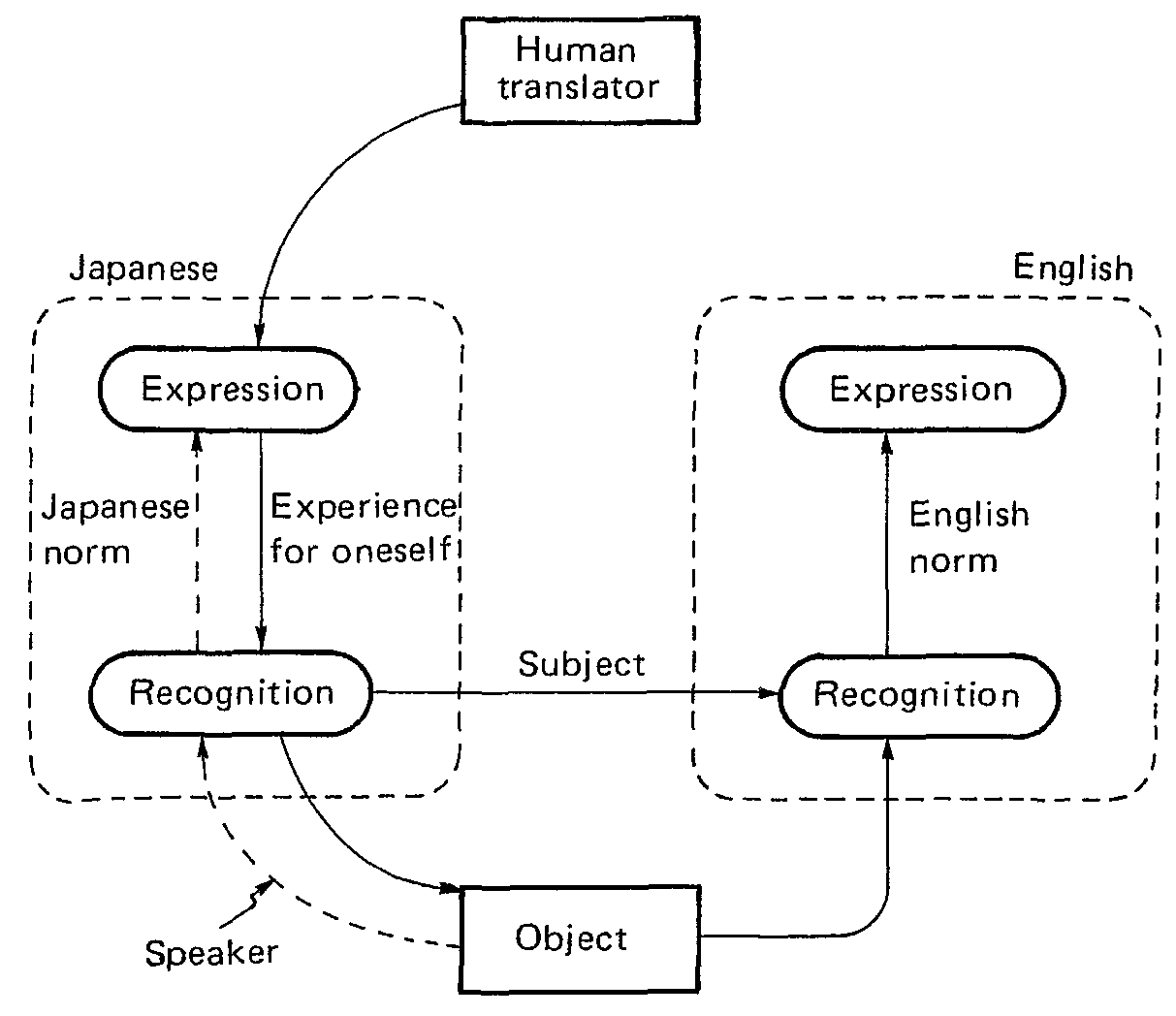
This translation process is similar to manual translation (Fig. 4). Here, a human translator first feels for himself, the speaker's experience as described by a given sentence. This process is supported by the Japanese norm that connects a speaker's recognition to Japanese expressions. Thus, the translator understands the state of the objects and the speaker's emotions and intentions towards the objects. In the MLMT method, the original Japanese sentence is separated into descriptions of the state of the objects and the speaker's emotions. The state of the objects is represented by a basic Japanese sentence (an objective expression) and the speaker's emotions are rearranged in a reference table.
|
In human translation, the state of the objects is then reorganized in the framework of English, and the speaker's emotions are recombined with it. Similarly, in the MLMT method, the meanings of objects are transferred into English by the three levels of the transfer method. The speaker's emotions, arranged in a reference table, are recombined to give the final English expressions.
In this method, syntactic structure and meaning are represented, by idiomatic patterns or Valentz patterns. They can not only be used for Japanese and English translation, but also for Japanese sentence analysis which results in fewer ambiguities than the ordinary method. Moreover, transfer rules are highly independent of each other; therefore, the consistency check is limited to a smaller range facilitating the expansion of the translation system.
Based on the constructive process theory of natural language, the multi-level machine translation method was proposed.
For machine translation, the importance of separating recognitions concerning subject and object, and retaining the meaning associated with syntactic structure was shown. The MLMT method consists of two sub-methods, which correspond to these two ideas: a separate and recombine method for subjective expressions, and a multi-level transfer method for objective expressions.
Ideally, to handle a syntactic structure and its meaning as one unit and thus to produce high quality translation, all possible expressions should be identified and included in the transfer rules. The open-ended characteristics of natural language make this technically impractical. As a technical compromise, expression structures are classified into patterns corresponding to abstraction levels of speaker's recognition, and subjective expressions are separated from the original sentences to improve the ratio of matching patterns.
The MLMT method was proposed for translating competent Japanese sentences into English. Proposed ideas about separating subjective expression and objective expressions, and the importance of the meaning of syntactic structure can be applied commonly to natural languages, then MLMT method will also operate with other natural languages.
The authors wish to thank the other members of our research group for helpful discussion.
 |
Satoru Ikehara Senior Research Engineer, Supervisor in the NTT Communications and Information Processing Laboratories. Since joining the ECL system in 1969, he has developed a formal algebraic manipulation language, queuing network analysis theory, and natural language processing system. He is presently developing a machine translation system. He received bachelor's degree, and master's degree, and Dr. Eng. degree from Osaka University in 1967, 1969 and 1983. He was awarded the dissertation prize in 1982 for his research on queuing network analysis from the Information Processing Society. He is a member of the Institute of Electronics, Information and Communication Engineers of Japan, and Information Processing Society of Japan. |
 |
Masahiro Miyazaki Senior Research Engineer, in the NTT Communications and Information Processing Laboratories. Since joining the ECL system in 1969, he has developed the computer system DIPS-11, performance evaluation theory for computer systems and Japanese-text-to-speech-systems. He is presently developing a machine translation system. He received a bachelor's degree in 1969 and Dr. Eng. degree from Tokyo Institute of Technology in 1986. He is a member of the Institute of Electronics, Information and Communication Engineers of Japan and the Information Processing Society of Japan. |
 |
Satoshi Shirai Senior Research Engineer, in the NTT Communications and Information Processing Laboratories. Since joining the ECL system in 1980, he has developed Japanese analysis systems for natural language processing systems. He is presently developing a machine translation system. He received bachelor's and master's degrees from Osaka University in 1978 and 1980. He is a member of the Institute of Electronics, Information and Communication Engineers of Japan, and the Information Processing Society of Japan. |
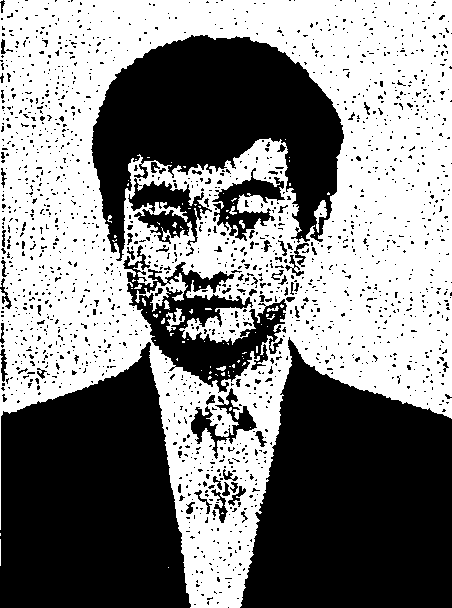 |
Akio Yokoo Research Engineer of the NTT Natural Language Processing Laboratory in the NTT Communications and Information Processing Laboratories. Since joining the ECL system in 1982, he has developed a frame representation language and a natural language processing systems. He is presently developing a machine translation system. He received a bachelor's in 1980 and master's degree in 1982 from the University of Electro-Communications. He is a member of the Institute of Electronics, Information and Communication Engineers of Japan, the Information Processing Society of Japan, and the Japanese Society Artificial Intelligence. |